

Project Story 05 Sannai Maruyama Overbridge
Sannai Maruyama Overbridge Harmonizing with a Jomon-period archaeological site while incorporating cutting-edge technology
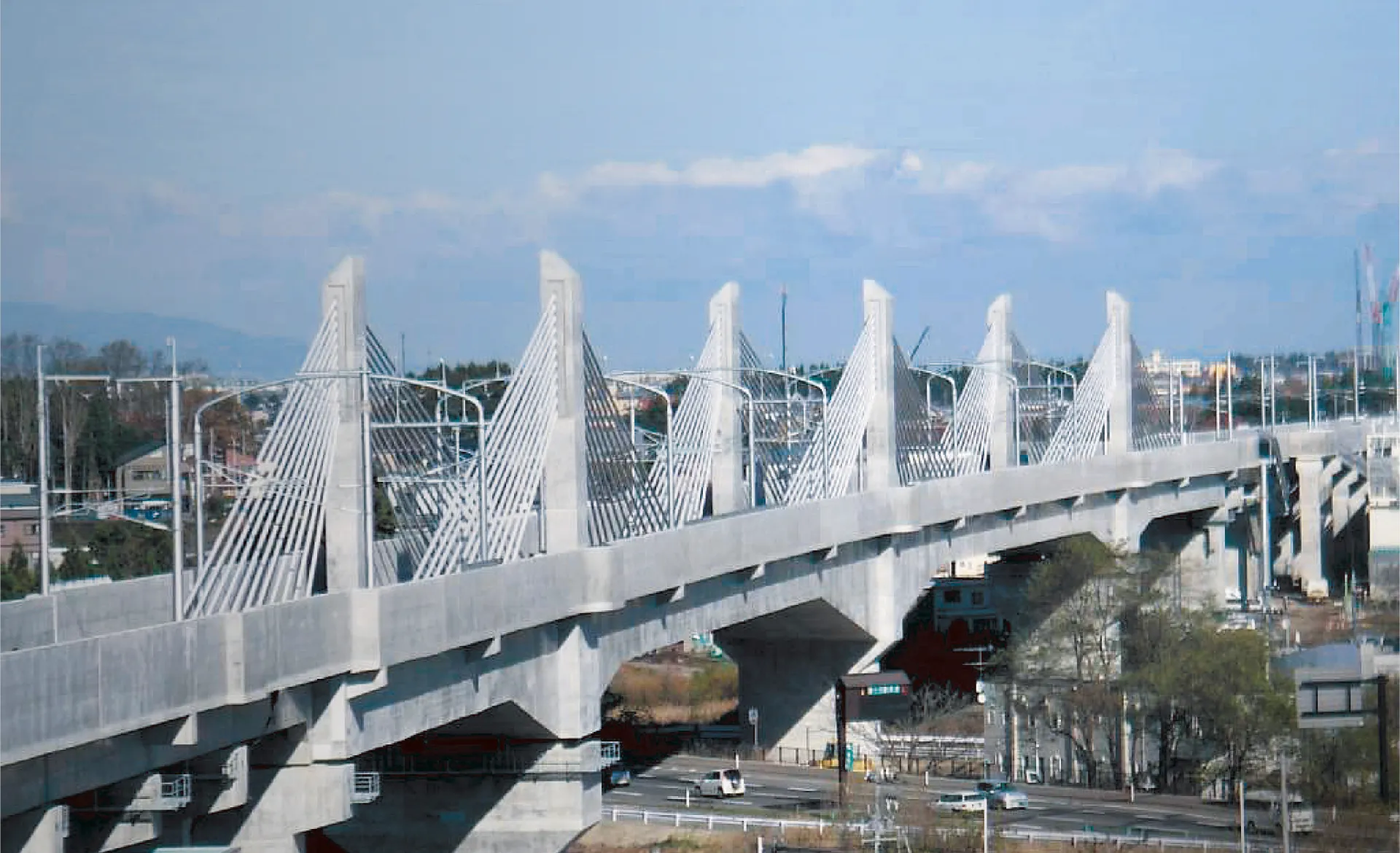
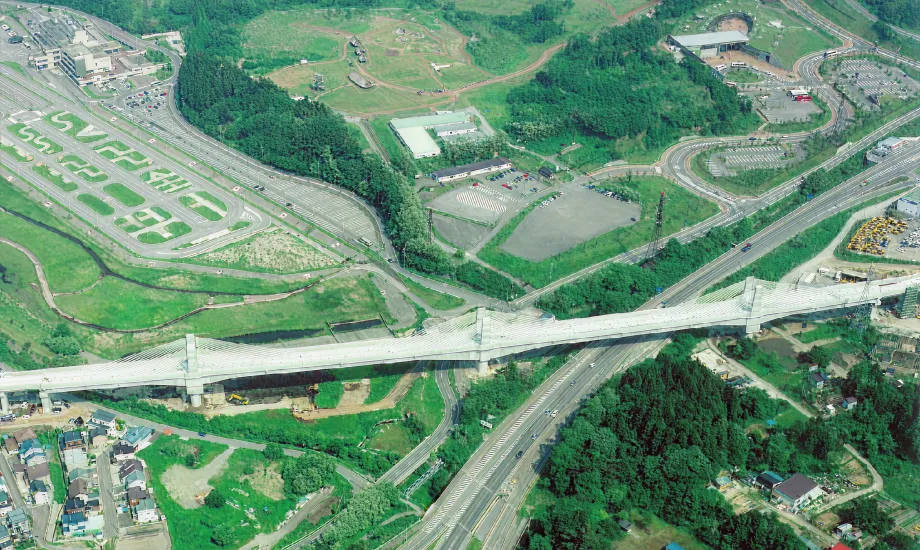
Located in Aomori City, Aomori Prefecture, the Sannai Maruyama Site is one of Japan’s largest and most significant Jomon-period settlement ruins, designated as a Special Historic Site. In 2021, it was also inscribed as a UNESCO World Cultural Heritage Site as part of the “Jomon Prehistoric Sites in Northern Japan.” Adjacent to this site is the Sannai Maruyama Overbridge on the Tohoku Shinkansen. Due to its location above a national highway slated for future expansion and over a floodwater retention area designated for emergency water storage, the bridge was designed as a viaduct with an exceptionally long span of 150 meters—the longest span for a high-speed rail bridge in Japan at the time. Because of its proximity to one of Japan’s most significant Jomon-period archaeological sites, a landscape-conscious design was adopted.
Features
 Design Consideration for a Difficult Location
—Harmonization with the Sannai Maruyama Site
Design Consideration for a Difficult Location
—Harmonization with the Sannai Maruyama Site
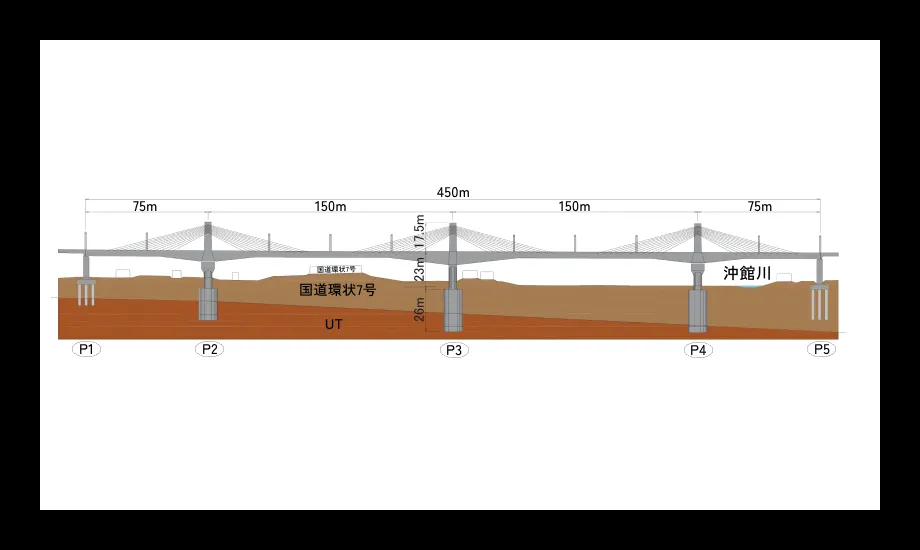
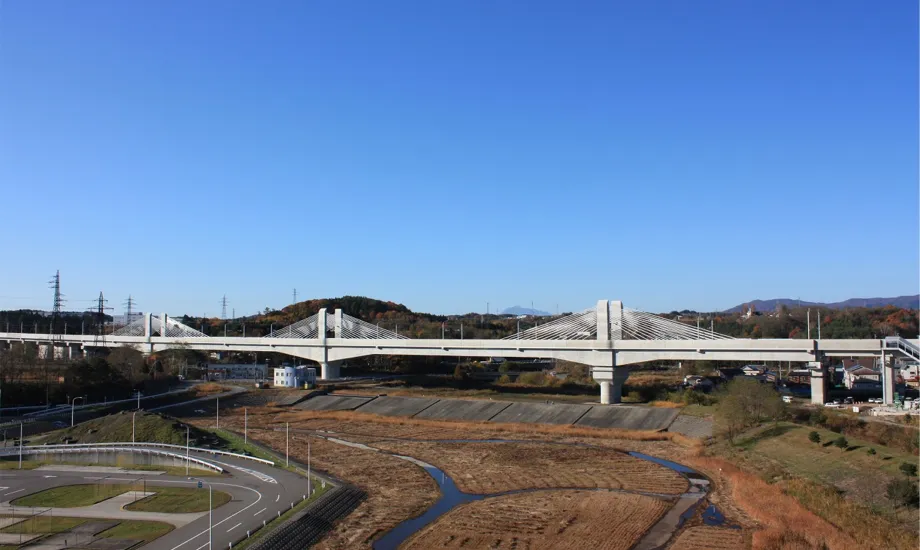
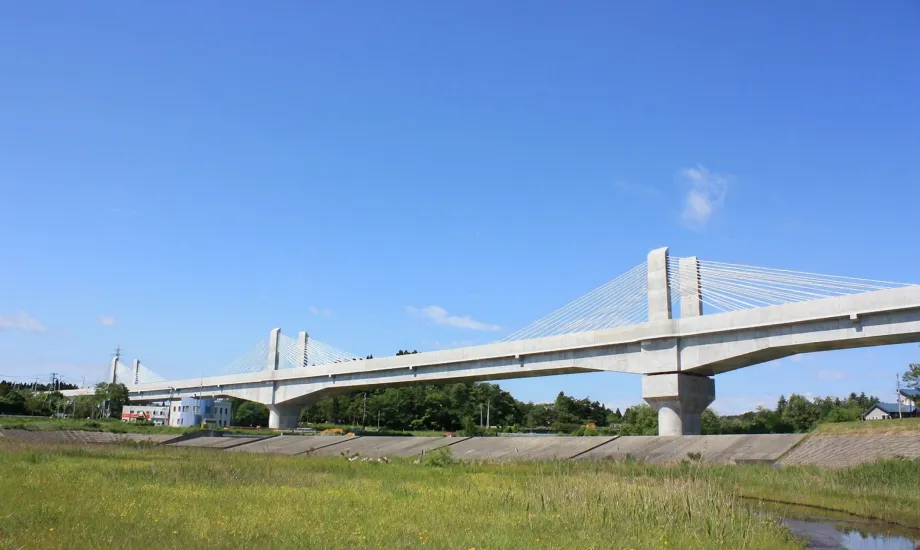
To ensure harmony with the adjacent Sannai Maruyama Site, the bridge was designed to minimize its visual impact. Due to site constraints, only three piers could be constructed along the bridge's total length of 450 meters, resulting in a 150-meter span—the longest ever for a Shinkansen bridge at the time.
The adopted bridge structure was an extradosed prestressed concrete box girder, which allows for long spans while maintaining a low structural profile. This type of bridge suspends the girder using cables stretched diagonally from the “main towers” that rise above the piers. Compared to typical cable-stayed bridges with a similar appearance, these main towers are shorter in height. For this bridge with a 150-meter span, the height of the main towers was deliberately kept low—40.5 meters from the top of the foundation to the summit, and 17.5 meters above the top of the girder—to ensure it remains out of sight from the adjacent Sannai Maruyama Site, which is screened by a stand of trees.
 Application of Newly Developed Technology
—Single-Pipe Saddle for Main Tower Cable System
Application of Newly Developed Technology
—Single-Pipe Saddle for Main Tower Cable System
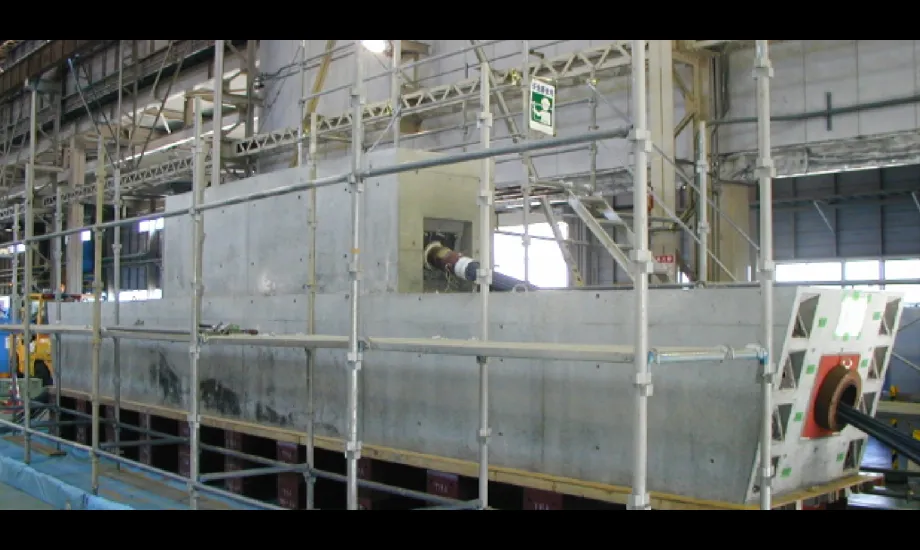
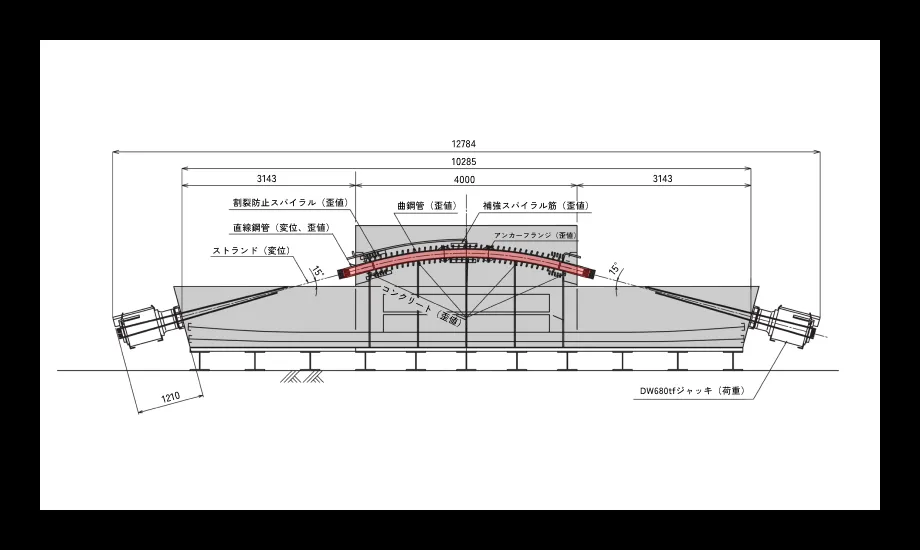
Many newly developed technologies were applied to this bridge. One of these is the single-pipe saddle, which was put into practical use for the first time on this bridge.
The stay cables that support the bridge girder pass through the main tower and extend to both sides. The component inside the tower that supports the stay cables is called a "saddle," named for its shape, which resembles a horse’s saddle. As the stay cables bear extremely large forces, the structure of the saddle is a critical element. Traditionally, most saddles used a double-pipe structure to support the cables. However, based on accumulated data, a new single-pipe saddle was developed to achieve better performance and cost efficiency.
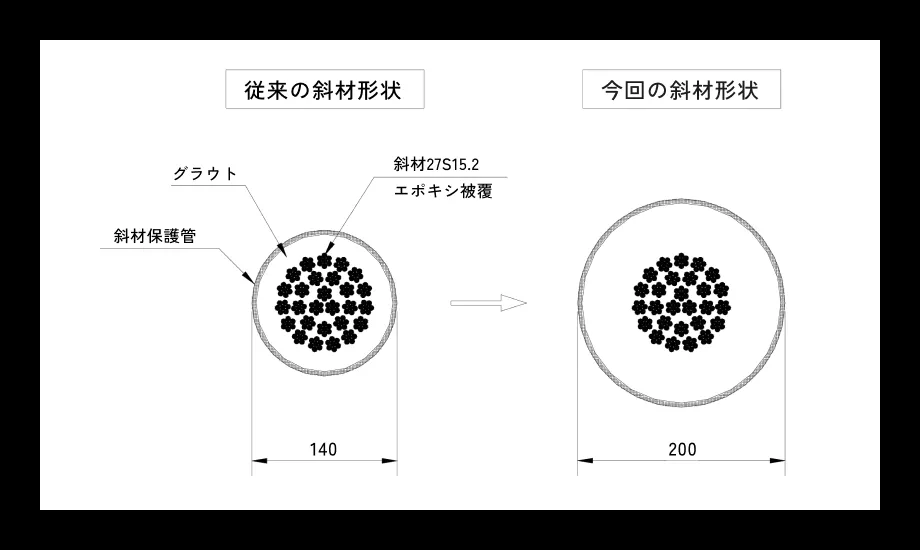
Furthermore, as the stay cables are primarily composed of metal, they are susceptible to thermal expansion and contraction. To minimize this effect, measures such as applying heat-reflective paint and increasing the thickness of the insulation layer by redesigning the protective pipe diameter were implemented.
 Recipient of the JSCE Tanaka Award and the Prestressed
Concrete Engineering Association Award
Recipient of the JSCE Tanaka Award and the Prestressed
Concrete Engineering Association Award
These new technologies have since been applied to numerous high-speed rail bridges constructed after this project, making this bridge a symbolic achievement and a significant technological milestone for extradosed bridges in high-speed rail infrastructure. In recognition of its pioneering role in enabling longer-span high-speed railway bridges, this bridge received both the 2008 Tanaka Award from the Japan Society of Civil Engineers and the 2008 Prestressed Concrete Engineering Association Award.
The JSCE Tanaka Award is named in honor of Dr. Yutaka Tanaka (1888–1964), a pioneering bridge engineer whose legacy greatly influenced Japanese bridge engineering. The award recognizes bridges that demonstrate outstanding achievement in planning, design, construction, and aesthetics. Our company has previously received this award for projects such as Kujira Bridge, Azumagawa Bridge, Amarube Bridge, and many others.
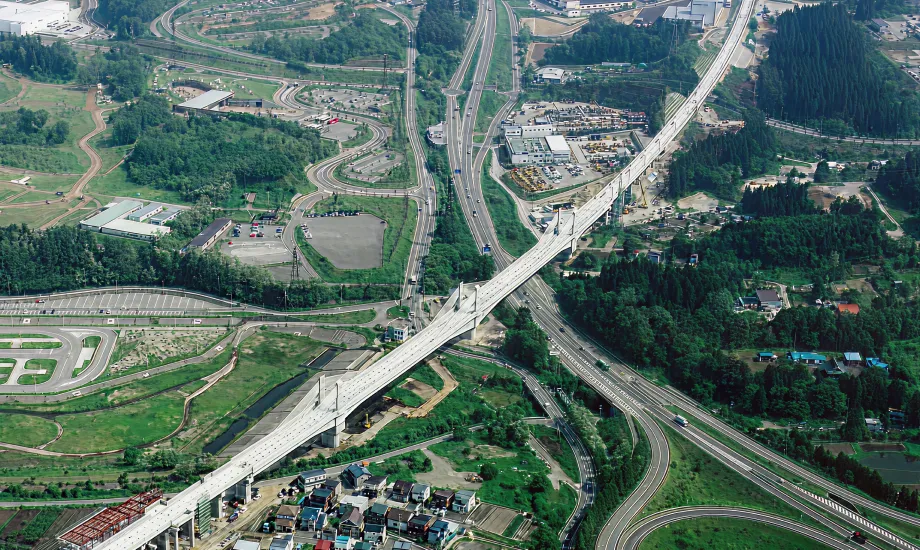
Harmony with the Ancient SiteHarmony with the Ancient Site
Project Overview
-
- Construction Site
-
Aomori City, Aomori Prefecture
-
- Project Owner
-
Japan Railway Construction, Transport and Technology Agency (JRTT)
-
- Design
-
Japan Railway Construction, Transport and Technology Agency (JRTT)
Chiyoda Engineering Consultants Co., Ltd.
-
- Construction Period
-
March 18, 2005 – December 15, 2008
-
- Project Overview
-
Prestressed concrete four-span continuous extradosed box girder bridge
Bridge length: 450.0 m (75.0 + 150.0 + 150.0 + 75.0 m)
-
- Awards
-
2008 JSCE Tanaka Award
2008 Prestressed Concrete Engineering Association Award